


Beijing, China
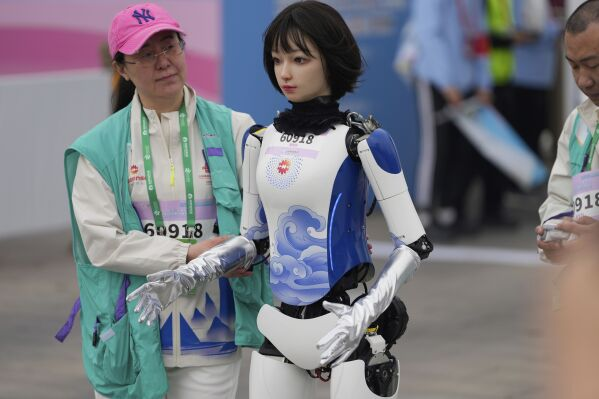
Over 20 humanoid robots participated in what was billed as the world’s first humanoid half-marathon in Beijing on Saturday, April 19, 2025.
Teams from various Chinese companies and universities entered robots of different shapes and sizes in the 21-kilometer (13-mile) race, which took place in Beijing’s southeastern Yizhuang district. The robots jogged alongside 12,000 human contestants in a separate, fenced-off lane.
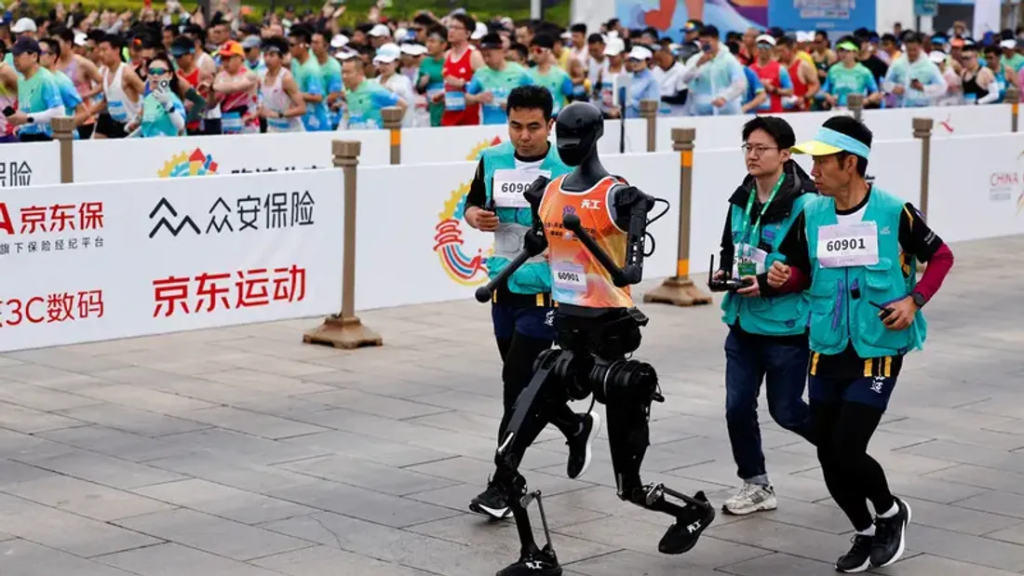
The top-performing robot, Tiangong Ultra, created by the Beijing Humanoid Robot Innovation Center, finished the half-marathon in two hours and 40 minutes. This time was nearly two hours slower than the current human world record of 56 minutes and 42 seconds, held by Ugandan runner Jacob Kiplimo. The winner of the men’s race among the human participants on Saturday completed the course in 1 hour and 2 minutes.
Despite the considerable time difference, Alan Fern, a professor of computer sciences, AI, and robotics at Oregon State University, expressed his surprise and admiration that any of the robots finished within the time limit. He noted that many companies in China, the US, and Europe are actively developing humanoid robots, but there is currently no clear leader in the field.
Tang Jian, the chief technology officer for the Beijing Humanoid Robot Innovation Center, attributed Tiangong Ultra’s performance to its long legs and an algorithm designed to mimic human marathon running. He claimed that Tiangong Ultra’s sporting achievements have not yet been matched by Western robotics firms. The 1.8-meter robot required three battery changes during the race and had a human helper running alongside it as a precaution against falls.
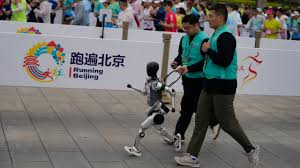
Most of the participating robots needed some form of support, with several being leashed or guided by remote control. In contrast, amateur human runners in the adjacent lane easily kept pace with the robots, with many even taking out their phones to record.