


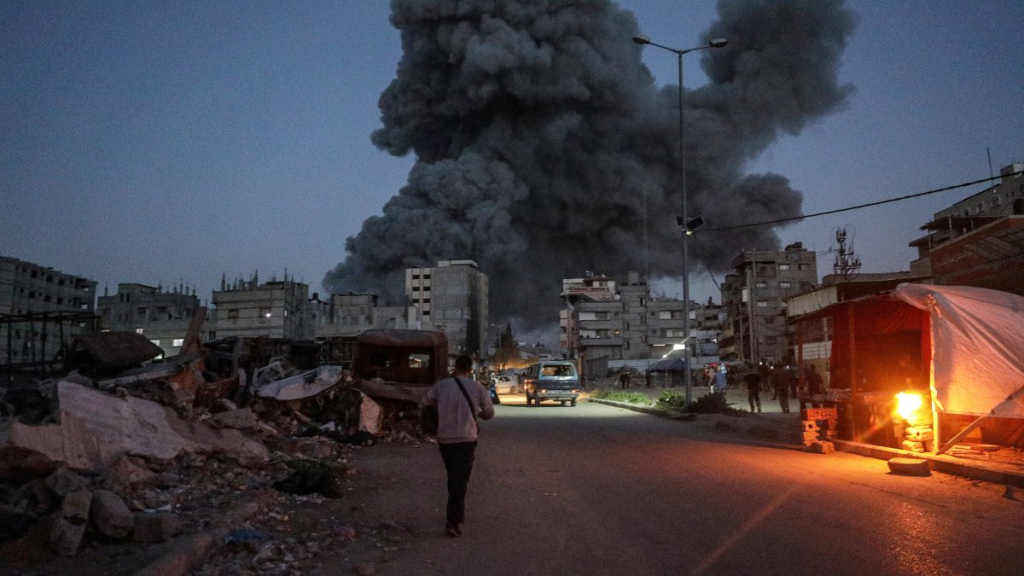
Israeli airstrikes on Thursday resulted in the deaths of at least 100 Palestinians across the Gaza Strip, according to Palestinian medical authorities. Among the casualties were at least 27 people who had been taking refuge inside a school.
The Health Ministry spokesperson, Zaher al-Wahidi, confirmed that 14 children and five women were among those killed at the school in the Tuffah neighborhood of Gaza City. He further stated that the death toll could increase, as some of the 70 individuals wounded sustained critical injuries. Additionally, more than 30 residents of Gaza lost their lives in strikes targeting homes in the nearby Shijaiyah neighborhood, as documented by medical records from Ahli Hospital.
The Israeli military justified the attack by claiming it had struck what it described as a “Hamas command and control center” in Gaza City. A similar justification was provided for an attack on a United Nations facility used as a shelter a day earlier, which resulted in the deaths of at least 17 people.
In response, Hamas denounced the attack on the school, calling it a “heinous massacre” of innocent civilians.
At Ahli Arab Hospital, injured Palestinian children, including a baby, received urgent medical attention following the attack on the school.
Meanwhile, Israel’s military issued orders for additional residents in parts of northern Gaza to relocate westward and southward to shelters, warning that the military intended to operate “with extreme force” in those areas. Many Palestinians fled on foot, carrying what little they could, while others used donkey carts for transportation.
Mohammad Ermana, a 72-year-old Palestinian, described his ordeal: “My wife and I have been walking for three hours, and we have barely covered a kilometer.” The elderly couple, each using a cane, struggled along the path. “I used to search for shelters every day. Now, I search for them every hour,” he lamented.
Israel has been issuing sweeping evacuation orders in preparation for further ground operations in northern Gaza. According to the United Nations humanitarian office, approximately 280,000 Palestinians have been displaced since Israel ended a cease-fire with Hamas the previous month.
New evacuation orders followed statements from senior Israeli government officials indicating that Israel planned to seize large sections of Palestinian territory and establish a new security corridor. The humanitarian situation in Gaza has worsened due to Israel’s prolonged blockade on essential supplies, including food, fuel, and humanitarian aid, leaving the civilian population in severe distress. Human rights organizations have condemned the blockade, asserting that it constitutes a war crime.
Hamas has declared that it is prepared to release the remaining 59 hostages it holds in exchange for the release of Palestinian prisoners, a permanent cease-fire, and the withdrawal of Israeli forces from Gaza. However, the group has refused to meet Israeli demands that it disarm or leave the territory.
Overnight airstrikes carried out by Israel claimed the lives of at least 55 Palestinians, according to hospital officials.
In the southern city of Khan Younis, the bodies of 14 victims were brought to Nasser Hospital, nine of whom were from the same family. Among them were five children and four women. At the European Hospital near Khan Younis, medical staff received the bodies of another 19 victims, including five children between the ages of one and seven and a pregnant woman. Meanwhile, in Gaza City, Ahli Hospital received 21 bodies, including those of seven children. Later in the day, additional airstrikes in Khan Younis killed four more people, while separate strikes in central Gaza left two dead, whose remains were taken to Al Aqsa Hospital.
The Israeli military announced that it would conduct an “independent investigation” into a March 23 operation in which Israeli forces fired upon ambulances in southern Gaza. The United Nations reported that 15 Palestinian medics and emergency responders were killed in the attack, with their bodies and the ambulances later buried in a mass grave by Israeli soldiers.
Initially, the Israeli military claimed the ambulances were acting suspiciously and alleged that nine militants were among those killed. The military stated that an expert fact-finding body would oversee the investigation to examine “exceptional incidents” during the war. However, human rights organizations have criticized such internal investigations, asserting that they often lack transparency and rarely result in accountability for soldiers involved in such actions.
Younes Al-Khatib, head of the Palestine Red Crescent Society, voiced his concerns before the United Nations Security Council, stating that some medics had likely been alive when Israeli forces reached the scene. He cited radio transmissions in Hebrew between medics and Israeli soldiers, which indicated that some responders were still conscious when the ambulances came under fire.
Riyad Mansour, the Palestinian ambassador to the U.N., presented video evidence to the Security Council, which he claimed captured the moments leading up to the Israeli attack on humanitarian workers in Gaza. According to Mansour, the footage, reportedly retrieved from one of the victims, showed that the aid workers—including eight members of the Palestinian Red Crescent Society—had been traveling in clearly marked emergency vehicles with flashing lights. Despite these visible signs, the Israeli army allegedly ambushed the convoy.
Israeli Prime Minister Benjamin Netanyahu announced on Wednesday that Israel would establish a security corridor across Gaza, increasing pressure on Hamas.
Israel has also reasserted control over the Netzarim corridor, a heavily militarized zone that effectively divides northern Gaza from the rest of the territory. Another corridor along Gaza’s southern border with Egypt runs from the Israeli border to the Mediterranean Sea. Netanyahu recently stated that Israel would maintain overall security control of Gaza even after the war and suggested that the country plans to implement U.S. President Donald Trump’s proposal for “voluntary emigration” of Palestinians.
Reports indicate that Israel’s military operations in Gaza have led to the deaths of over 50,000 Palestinians, with more than half of the victims being women and children, according to Gaza’s Health Ministry. The war has left much of the territory in ruins and displaced approximately 90% of its population at its peak.
The war originated from Hamas’ October 7, 2023, attack on southern Israel, which resulted in approximately 1,200 Israeli deaths and the taking of 251 hostages. While most hostages have been released through cease-fire negotiations and other deals, Israel has managed to rescue eight living hostages and has recovered numerous bodies.
On Thursday, Netanyahu arrived in Hungary for his second foreign visit since the International Criminal Court (ICC) issued an arrest warrant against him in November over allegations of war crimes in Gaza. The ICC, headquartered in The Hague, Netherlands, has stated that there is sufficient evidence to believe that Netanyahu and former Israeli Defense Minister Yoav Gallant deliberately restricted humanitarian aid to Gaza as a “method of warfare” and intentionally targeted civilians.
Under international law, ICC member states, including Hungary, are required to arrest individuals facing such charges if they enter their territory. However, compliance with the court’s decisions is voluntary, and Hungary announced that it would begin the process of withdrawing from the ICC upon Netanyahu’s arrival in Budapest.
Meanwhile, in Lebanon, an apparent Israeli airstrike early Friday hit a multistory apartment building in the coastal city of Sidon, killing at least two people. An Associated Press photographer at the scene reported seeing emergency responders removing two bodies from the rubble.
The Israeli military has yet to issue an official statement regarding the strike. It marks the first time Sidon has been targeted since a fragile cease-fire was established in late November. Despite the cease-fire, Israel has continued to conduct airstrikes in Lebanon, primarily targeting Hezbollah and its allies.
Daily Sabah/NGG