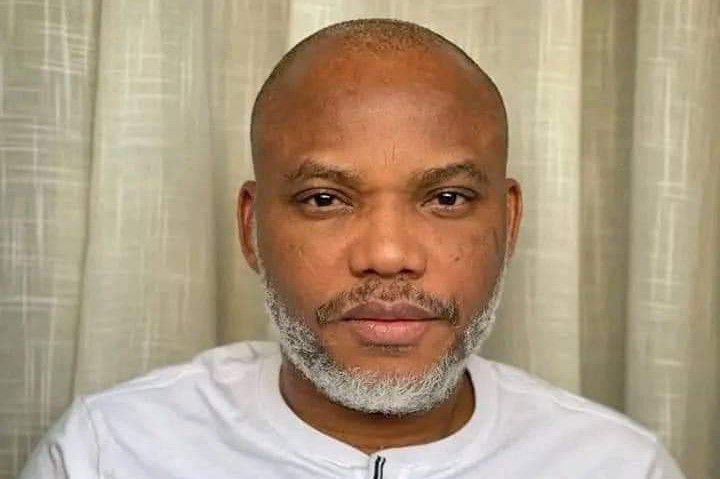


The Federal High Court in Abuja has found Nnamdi Kanu guilty of terrorism 10 years after he was first arrested, following years of legal battle between Nnamdi Kanu and the Nigerian government.
Justice James Omotosho announced Kanu’s conviction in a lengthy judgment delivered on Thursday, November 20. The court said it was satisfied that Nnamdi Kanu had made a series of broadcasts to incite violence and killings, as part of his campaign for a separate state in south-east Nigeria, known as Biafra.
On the count of terrorism, Justice Omotosho said: “It is clear from the evidence that the defendant committed a terrorism act. The defendant is convicted in respect of count one.” Kanu was convicted on at least six of the seven charges he faced, with the judge continuing to deliver his ruling as of the time of the initial reports.
Delivering his judgement, Judge Omotosho said: “Mr Kanu knew what he was doing, he was bent on carrying out these threats without consideration to his own people. From the uncontroverted evidence, it is clear that the defendant carried out preparatory act of terrorism. He had the duty to explain himself but failed to do so.”
Nnamdi Kanu has been the leader of the Indigenous People Of Biafra (IPOB), a movement demanding independence that was banned as a terrorist organisation in 2017. Its armed wing, the Eastern Security Network, has been accused of killings and other acts of violence in recent years, which prosecutors argued were incited by Kanu’s broadcasts and orders. The final charge count is expected to include the declaration of sit-at-home in the South-East region of Nigeria, which the prosecution argued amounted to an act of terrorism.
In court ahead of the verdict, Kanu insisted that proceedings could not continue because he had not yet filed his final written address, accusing the judge of bias and not understanding the law. He had also argued that the court has no jurisdiction to try him and rejected Count 7 regarding the sit-at-home order. The judgment was delivered after Nnamdi Kanu had been forcibly removed from the courtroom for unruly behaviour, after he demanded that the judge show him the law.
Kanu was first arrested in October 2015, but he jumped bail in 2017 and left the country after a military raid on his home. The court later revoked his bail in March 2019, and he was re-arrested in 2021 in Kenya and extradited to Nigeria.